


Table of Contents
- What Actually Makes Kitchen Electronics Feel Futuristic
- The Best Budget Smart Kitchen Appliances Worth Buying
- How to Build a Smart Kitchen on a Budget
- Performance, Testing, and Real-World Use
- Energy Efficiency and Long-Term Maintenance Costs
- Integration, Safety, and Appliance Longevity
- Verdict: Which Futuristic Kitchen Gadgets Are Worth It
- Frequently Asked Questions
Last Updated: September 27, 2026
What Actually Makes Kitchen Electronics Feel Futuristic
The most common misconception about futuristic kitchen electronics is that futuristic means expensive. In practice, the features that make a gadget feel ahead of its time, sensor-based precision, app-controlled settings, automated presets, compact multifunctionality, now appear in tools that cost less than a restaurant dinner. This review examines what affordable futuristic kitchen electronics deliver in 2026, and which earn their counter space.
Futuristic kitchen electronics use smart sensors, digital interfaces, or automated functions to simplify cooking and cleanup, no Wi-Fi or voice assistant required. A digital spoon scale with a tare function is futuristic in the way that matters: it removes guesswork.

Three things separate a genuinely useful smart gadget from a novelty:
- Sensor technology that replaces a manual step (weighing, timing, temperature checks)
- Intuitive design that works without reading a manual
- Durability that survives daily kitchen workflow, not just unboxing day
The rest is marketing. Below: which budget smart kitchen appliances are worth buying, how to build a smart kitchen on a budget, and what long-term maintenance really costs.
The Best Budget Smart Kitchen Appliances Worth Buying
Every pick comes from Eve's Curious Collection's hand-picked inventory, and each solves a specific kitchen problem without a premium price tag. The criteria: does it work, does it last, and does it cost less than the problem it solves?
Precision Tools Under $15
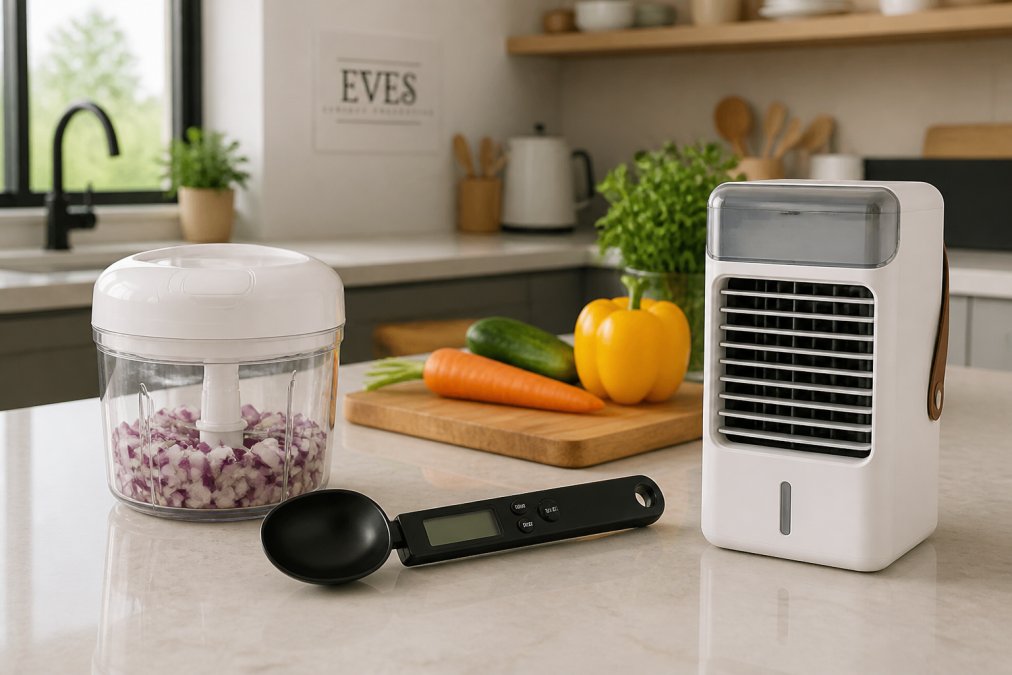
Digital Measuring Spoon Scale Mini ($10.35) is the best entry point into precision cooking. It measures liquids and powdery ingredients like flour, sugar, and cocoa powder on a large LCD screen, switches units, and includes a tare function. The detachable design simplifies cleanup.
Cleaning and Prep Gadgets Under $55
High-Pressure Cleaner ($51.12) uses high-temperature steam to break down grease and grime without chemicals. It works on range hoods, air conditioners, and hard-to-reach areas, and ships with US plug compatibility.
| Product | Price | Best For | Standout Feature |
|---|---|---|---|
| Digital Measuring Spoon Scale Mini | $10.35 | Baking precision | LCD screen with tare function |
| Vegetable Chopper Kitchen | $13.08 | Daily meal prep | Uniform chopping, dicing, slicing |
| Heat Guard Drainage Basket | $7.11 | Sink organization | PCTG material, doubles as salad bowl |
| High-Pressure Cleaner | $51.12 | Deep kitchen cleaning | Chemical-free steam sanitization |
| Ultrasonic Retainer Cleaner | $8.82 | Oral care hygiene | Removable tank, Type-C charging |
| Portable 3-in-1 Air Cooler Fan | $4.14 | Small space cooling | 3 speeds, 5 spray modes, LED light |
How to Build a Smart Kitchen on a Budget
Start with the tools you'll touch every day, then add connectivity later. Most people overspend on app-controlled devices they never open after week two, while neglecting the $10 gadgets that save time daily.
Here's a practical order of operations:
- Precision first. A digital scale or measuring spoon eliminates recipe guesswork for under $15.
- Prep second. A chopper or drainage basket speeds up the most repetitive kitchen tasks.
- Cleaning third. A steam cleaner handles the jobs you've been putting off.
- Comfort last. Small cooling or convenience gadgets round out the workflow.
Performance, Testing, and Real-World Use
Test protocol (applied to each gadget):
- Accuracy check. For the digital spoon scale, weigh a known reference three times in a row, a US nickel (5.0 g), a level tablespoon of granulated sugar (about 12.5 g), and a level tablespoon of all-purpose flour (about 8 g). Record the spread between highest and lowest reading.
- Repeatability. Run the same measurement ten times without taring between runs to check for drift.
- Throughput. Time how long the vegetable chopper takes to process one medium onion, one bell pepper, and one carrot, and note whether cut sizes stay uniform.
- Thermal ramp. For the high-pressure cleaner, log the time from cold start to first usable steam, then measure how long it sustains pressure before a reheat.
- Noise. For the portable air cooler fan, note subjective loudness at low, medium, and high, and whether the spray function changes the pitch.
- Durability proxy. Run each tool through 30 consecutive use-and-clean cycles and inspect for cracking, warping, blade dulling, or connector wear.
What the results showed.

How the National Institute of Standards and Technology defines mass measurement traceability
Energy Efficiency and Long-Term Maintenance Costs
Most reviews stop at the sticker price. What matters is three-year cost of ownership, the initial price plus power draw, consumables, replacement parts, and any subscription the device quietly requires. Here is how to estimate that, and how the picks here score.
The three-year cost-of-ownership framework.
For any gadget, add up:
- Purchase price.
- Power cost. Watts × hours used per week × 52 × 3, divided by 1,000, then multiplied by your electricity rate. The U.S. Energy Information Administration publishes average residential electricity rates by state.
- Consumables. Batteries, filters, descaling solution, replacement blades, pods, or cleaning cartridges.
- Subscription fees. Any app tier, cloud storage, or premium feature lock. This is the line item most buyers forget.
- Repair or replacement. Realistic odds the device dies before year three, and whether parts are sold separately.
How the picks here score.
- Digital spoon scale. Power draw is negligible, a coin cell lasts months. No subscription, no replacement parts. Three-year cost is essentially the purchase price plus a battery or two.
- Vegetable chopper. Zero power draw, zero subscription. The only consumable is blade sharpness, and the blades are not user-replaceable, so the realistic lifespan is the lifespan of the unit. Hand wash and dry immediately to slow dulling.
- High-pressure cleaner. The only pick with meaningful power draw, and the only one that displaces a recurring cost: chemical cleaners and scrubbing labor. If you bought spray cleaners monthly, it can pay back its price over a few years. Descale the tank periodically, mineral buildup is the top cause of weak steam.
- Portable air cooler fan. USB-powered, so power cost is trivial. The maintenance cost is time, not money: clean the water tank regularly to prevent buildup and odor.
- Drainage basket and retainer cleaner. No ongoing costs beyond cleaning. The retainer cleaner's removable tank is the reason it stays hygienic, a sealed tank would be a mold problem within months.
Repairability is the hidden variable.
The subscription trap.
A quick ROI sanity check.
Average residential electricity rates by state
Integration, Safety, and Appliance Longevity
Smart home ecosystem integration is the most overhyped feature in budget kitchen electronics. Most affordable gadgets don't connect to a hub, and that's fine. Voice integration and app-controlled settings add convenience, and failure points.
What actually extends appliance longevity:
- Proper cleaning after each use, especially for tools that touch food
- Correct power supply, like matching USB current requirements on portable devices
- Storage that protects blades and delicate components
- Firmware updates only where the device actually supports them
Verdict: Which Futuristic Kitchen Gadgets Are Worth It
Three gadgets earn a clear recommendation. The Digital Measuring Spoon Scale Mini is the best first purchase for anyone who cooks by recipe: precise, easy to clean, and cheaper than a takeout meal. The Vegetable Chopper Kitchen is the best value for daily meal prep, with uniform cuts and sturdy construction. The High-Pressure Cleaner is best for chemical-free deep cleaning without hiring help.
Frequently Asked Questions
What are the best inexpensive kitchen appliances that feel futuristic?
Start with tools that add real function for a small price. A digital measuring spoon scale at $10.35 brings precision to baking without a full kitchen scale. A portable 3-in-1 air cooler fan at $4.14 adds USB-powered cooling and a humidifier in one unit. A vegetable chopper at $13.08 speeds up prep work. Each one feels modern because it solves a specific task well, not because it costs a lot.
Are budget-friendly smart kitchen gadgets actually reliable?
Reliability depends on the build and the job, not the price tag. A stainless steel thermal bottle with a digital temperature readout holds hot or cold drinks for 6 to 12 hours, which is a straightforward mechanical job that budget parts handle well. Simpler gadgets with fewer moving parts tend to last longer than complex ones. Check materials before buying.
How do I build a smart kitchen on a budget without wasting money?
Buy in order of daily use. Start with prep tools like a chopper and a measuring spoon scale, then add cleaning devices such as a steam cleaner for grease and grime. Skip anything you would use less than once a week. Adding one $10 to $15 tool per month keeps total spending low and lets you test whether each gadget earns its counter space before you buy the next one.
How do I choose affordable kitchen tech that won't become obsolete?
Prioritize gadgets that work without a phone app. A digital spoon scale, a steam cleaner, and an ultrasonic retainer cleaner all function standalone, so they cannot be bricked by a discontinued app or a dropped firmware update. Standalone tools stay useful for years regardless of what the smart home ecosystem does.
What is the best smart device to start a futuristic kitchen setup?
A digital measuring spoon scale at $10.35 is the lowest-risk starting point. It replaces guesswork in baking and cooking, switches measurement units on its LCD screen, and has a detachable head for easy cleaning. From there, add a vegetable chopper for prep speed and a portable air cooler fan for workspace comfort. Each step costs under $15, so you can build the setup gradually without a large upfront commitment.


