


Table of Contents
- What Curated Shopping Actually Means (Beyond the Marketing Speak)
- The Real Benefits of Curated Shopping
- Is the 5 Gift Rule Effective for Curated Gift-Giving?
- The True Cost of Curated Shopping: ROI and Value Proposition
- How to Build a Curated Wardrobe Without Overspending
- The Psychological Impact of Curated Shopping
- How to Spot Authentic Curation vs. Curation-Washing
- Conclusion
Last Updated: August 22, 2026
What Curated Shopping Actually Means (Beyond the Marketing Speak)
Curated shopping is the practice of a human editor hand-selecting products based on defined quality criteria and aesthetic coherence, rather than aggregating whatever suppliers offer at the lowest margin. The real distinction: a curated collection starts with a standard and works backward to find products that meet it. A mass-market catalog starts with supplier relationships and works forward to justify inventory.
At Eve's Curious Collection, we think about curated shopping as an edited selection process where the goal is to surface items you didn't know you needed until you saw them. The concept draws from Scandinavian minimalism, where intentional consumption means owning fewer things that work harder. Applied to retail, it means a boutique marketplace model: smaller inventory, higher scrutiny per item, and a clear point of view about what belongs.
Curated shopping is not the same as "premium shopping." Price is a byproduct of the curation process, not the goal. The best curated collections include genuinely affordable items alongside higher-ticket ones; the common thread is thoughtful design and a clear reason for inclusion.
The Real Benefits of Curated Shopping
The strongest argument for curated shopping is about time. Market saturation has made ordinary online shopping exhausting. Search for any product category on a major platform and you'll find hundreds of near-identical listings with manipulated reviews. A well-run curated marketplace collapses that decision space. Instead of evaluating 400 options, you're choosing from 12, and someone with relevant expertise has already filtered the field.

Vendor Vetting and Quality Assurance
Authentic curation requires vendor vetting that most shoppers never see. A credible curated retailer evaluates suppliers on material quality, manufacturing practices, supply chain transparency, and whether the product actually does what it claims. The practical result is quality assurance that's invisible but real. When a product passes that process, you're buying the confidence that someone with relevant expertise already stress-tested it.
According to Harvard Business Review's research on consumer trust and retail, consumers consistently underestimate the value of pre-purchase quality filtering, even when they report high frustration with returns and product disappointment.
Decision Fatigue and Shopping Efficiency
Decision fatigue is a real cognitive phenomenon. Research documented by the American Psychological Association on choice overload confirms that excess options frequently lead to worse decisions and lower satisfaction. Curated shopping sidesteps this by design. An edited selection means fewer decisions of lower cognitive cost, which typically results in higher satisfaction with what you buy. This matters especially for gift-givers, where finding something genuinely personal is hard work.
Is the 5 Gift Rule Effective for Curated Gift-Giving?
The 5 Gift Rule limits presents to five categories: something to wear, something to read, something you want, something you need, and something to experience. It works because it forces intentional consumption over impulse buying, which is exactly the mindset that makes curated shopping effective.
For curated gift-giving, the rule is highly effective. It prevents buying volume to compensate for uncertainty. Instead of five mediocre items, you're selecting one or two things that genuinely fit a category and reflect real thought about the recipient. Curated shopping helps because a well-edited selection surfaces unexpected items that fit real human needs.
| Gift Rule Category | What to Look For in a Curated Collection | Example Approach |
|---|---|---|
| Something to wear | Accessories, jewelry, functional wearables | Breathing Necklace for Anxiety |
| Something you want | Trending finds, novelty items | LoveStack Couples Game |
| Something you need | Household supplies, personal care | Anxiety Bookshelf |
| Something to experience | Games, interactive tools | Couples games, fidget tools |
| Something to read | Guided journals, curated book collections | Anxiety-focused reading sets |
The rule pairs naturally with curated shopping because both are built on intentionality over volume.

The True Cost of Curated Shopping: ROI and Value Proposition
The real question is what you're paying for per unit of satisfaction, per product that actually gets used. Some curated collections charge a genuine premium reflecting real costs: product testing, vendor vetting, inventory management, and selection expertise. Others charge a premium reflecting only branding and marketing spend.
Price transparency is the differentiator. A curated retailer that explains why a product costs what it does, materials, sourcing standards, selection process, is charging for something real. One offering vague language about "quality" is engaging in curation-washing.
The cost-per-wear framework is useful here. A $34 item used weekly for two years has lower effective cost than a $12 item used twice. Curated shopping shifts your portfolio toward the former, justifying the price difference versus buying the cheapest option.
Curation-washing has created genuine fatigue. So many retailers describe inventory as "curated" that many shoppers have stopped believing the claim. Authentic curation must prove itself through behavior: return policies, product descriptions with honest limitations, and visible selection criteria all signal authenticity. According to McKinsey's consumer behavior research on retail trust, consumer trust in retail branding has declined as the gap between marketing claims and product reality has widened.
How to Build a Curated Wardrobe Without Overspending
Building a curated wardrobe means buying fewer things that work harder, not buying expensive things. The framework breaks down into three phases:
-
Audit what you own. Pull everything out and identify what you actually wear versus what occupies space.
-
Define your standard before you shop. What materials wear well for your lifestyle? What silhouettes feel comfortable? What colors work across multiple combinations?
-
Apply cost-per-wear thinking to every purchase. A $50 item worn 100 times costs $0.50 per wear. A $15 item worn twice costs $7.50 per wear.
The practical mistake most people make is confusing "curated" with "expensive." The goal is an edited selection of items that genuinely fit your life.
The Psychological Impact of Curated Shopping
Authentic curated shopping reduces choice overload, the anxiety that comes from too many options. When you trust that someone has already filtered the field, your brain engages with remaining choices more calmly and confidently. The result is higher purchase satisfaction and fewer post-purchase regrets.
There's also a social dimension. Discovering something through a curated channel feels like a recommendation from someone with taste and knowledge, rather than a result optimized for click-through rates. That feeling of exclusive access increases perceived value.
The negative effect kicks in when curation is revealed to be performative. Curation-washing doesn't just disappoint in the moment; it creates lasting skepticism. Shoppers who feel misled by a "curated" label become harder to convince with any curated claim afterward.
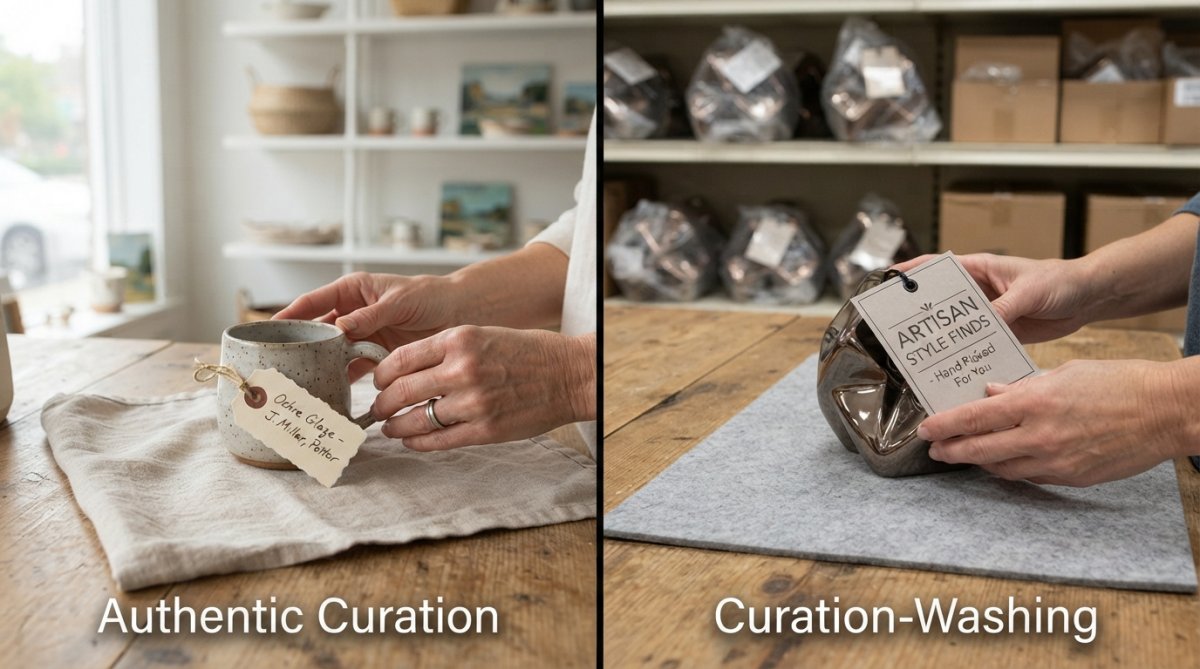
How to Spot Authentic Curation vs. Curation-Washing
The difference between authentic curation and curation-washing is usually visible if you know what to look for:
- Selection criteria are stated explicitly. Can the retailer tell you what standards a product must meet?
- Product descriptions include honest limitations. Authentic curation acknowledges trade-offs.
- Inventory is genuinely edited. A boutique marketplace with 15,000 SKUs is not curated.
- The selection reflects a coherent point of view. Products should feel like they belong together.
- The retailer can explain why a product was chosen. Not just what it does, but why it earned a place.
- Brand equity is built on product performance. Look for return policies and guarantees signaling confidence.
- Supply chain transparency is available on request. Authentic curators know where products come from.
The resale market offers an interesting quality signal. Products from genuinely curated collections tend to hold value better in secondary markets because they were selected for intrinsic quality rather than trend appeal. According to the FTC's guidelines on marketing claims and consumer protection, marketing language that overstates product selection processes can cross into deceptive trade practice territory.
The hardest part of curated shopping is finding a collection that's actually curated. Eve's Curious Collection hand-picks every item with a clear point of view: things you didn't know you needed, that turn out to be exactly right. From the Breathing Necklace for Anxiety to the LoveStack Couples Game, the selection reflects genuine curation rather than catalog expansion. Fast shipping means the discovery doesn't have to wait. Shop Now and find something that earns its place in your life.

Frequently Asked Questions
Is paying a premium for curated goods worth the investment?
It depends on what you value. Curated shopping saves time by eliminating hours of browsing and filtering low-quality options. The premium typically covers vendor vetting, product testing, and the expertise behind the edited selection. If you regularly experience decision fatigue or have bought cheap products that failed quickly, the cost-per-wear or cost-per-use math often favors a curated purchase over multiple cheap replacements.
What is the 5 gift rule and how does it relate to curated shopping?
The 5 gift rule suggests giving one gift each in five categories: something to wear, something to read, something they want, something they need, and something to do. Curated shopping aligns naturally with this framework because a good boutique marketplace has already filtered products into meaningful categories, making it easier to find intentional, thoughtful gifts rather than last-minute fillers. It turns gift-giving into a purposeful process.
How do you determine if a curated service provides real value?
Check three things: whether the platform explains its vetting process openly, whether product descriptions go beyond marketing copy to include honest trade-offs, and whether the inventory changes regularly rather than sitting stagnant. Authentic curation involves real people making real decisions about what earns shelf space. If a site cannot tell you how products are selected, that is curation-washing, not genuine editorial judgment.
How does curated shopping save time for busy professionals?
A well-curated boutique marketplace does the research upfront. Instead of comparing dozens of similar items across multiple platforms, you browse a pre-filtered selection where low-quality options have already been removed. For busy professionals, that time savings is the core value proposition. Rather than spending an evening reading reviews, you spend five minutes finding something that works.
This article was written using GrandRanker


