


Table of Contents
- Start With a Personal Aesthetic Blueprint
- The Best Online Home Decor Shops for One-of-a-Kind Finds
- How to Source Vintage and Antique Pieces Locally
- How to Style Eclectic Home Decor Without the Clutter
- How to Mix Modern and Vintage Decor in One Room
- Sustainable and Ethical Sourcing: How to Verify What You Buy
- Budget-Friendly Ways to Get the High-End Look
- Frequently Asked Questions
Last Updated: September 14, 2026
Start With a Personal Aesthetic Blueprint
Finding unique home decor starts with knowing what "unique home decor" means for you, not for an algorithm. A personal aesthetic blueprint records the colors, textures, eras, and moods you respond to, and it prevents impulse buys that never fit.
This guide walks through where to shop, how to verify quality, and how to style pieces once they arrive.
Most people skip this step, then wonder why a purchase feels random six months later. Save 30 to 50 images you love, then look for patterns.
Build a Mood Board That Actually Guides You
A mood board only works if it constrains your decisions instead of decorating your screen. Group saved images into colors, textures, and shapes; if the same warm terracotta shows up in eleven photos, that is a signal.
Try this structure:
- Palette: three to five colors you keep returning to
- Materials: wood, ceramic, brass, linen, glass, stone
- Scale: do you gravitate toward small collections or one large statement piece?
- Era: mid-century, Victorian, contemporary, or a deliberate mix
Include one or two pieces you already own and love; anchoring new purchases to something real keeps the plan grounded.
The Best Online Home Decor Shops for One-of-a-Kind Finds
The best online home decor shops for one-of-a-kind finds fall into three categories: curated marketplaces, independent artisan shops, and resale platforms. Each has a different failure mode, and knowing which you are browsing changes how you search.
Curated Marketplaces vs. Independent Artisan Shops vs. Resale Platforms
Curated marketplaces vet sellers and handle shipping, returns, and payment in one place. The trade-off: popular marketplaces increasingly stock the same trending items, so "unique" can mean "unique this month." Search the exact product name, if the same listing appears on five marketplaces with identical stock photography, it is a mass-produced import.
Independent artisan shops are the opposite. You wait longer and pay more for shipping, but you can ask the maker directly about materials, batch size, and whether a design will be repeated. Provenance is the product, a maker who can describe the clay body, glaze recipe, and kiln schedule sells something a marketplace cannot replicate.
Resale platforms sit between the two. Inventory is genuinely one-of-a-kind because it is used, but condition varies wildly and returns are often limited to "not as described" claims. Resale is strongest for vintage and antique decor, weakest for anything in a specific size or color.
| Source Type | Best For | Typical Trade-off |
|---|---|---|
| Curated marketplaces | Browsing across many categories | Overlap with trending inventory |
| Independent artisan shops | Provenance and small-batch work | Longer shipping, fewer returns |
| Resale platforms | Genuinely one-of-a-kind vintage | Condition risk, limited returns |
| Local markets and estate sales | One-of-a-kind and vintage | Requires in-person time |
Search Operators and Filters That Surface Unique Inventory
Most shoppers browse the same default feeds. A few search habits cut through:
- Search by material and technique, not by room. "Hand-thrown stoneware vase" returns different results than "vase for living room."
- Use negative keywords to strip out mass-produced noise. Adding
-dropship -aliexpress -temuto a search removes a large share of imported listings. - Sort by "newest" rather than "popular" on artisan marketplaces. Popularity sorting rewards the same bestsellers everyone else is buying.
- Filter by "made to order" or "one of a kind" where the platform supports it. Made-to-order pieces are rarely mass-produced.
- Follow makers, not shops. A single artisan's new collection is more likely to be genuinely limited than a shop's rotating catalog.
How to Vet a Maker Before You Buy
A short checklist separates real small-batch work from a storefront reselling imports:
- Does the listing name the maker, workshop, or studio?
- Are materials described specifically (stoneware, walnut, unlacquered brass) rather than as "premium" or "mixed"?
- Are dimensions and weight listed, or only a lifestyle photo?
- Does the shop show process photos, not just finished product shots?
- Is there a stated batch size or a note that the design will not be repeated?
- Can you find the maker's name outside the platform, such as a studio site or a craft fair listing?
If a shop cannot answer the first two questions, treat the "handmade" claim as marketing.
Use marketplaces for discovery and artisan shops for pieces you want to keep for a decade. Treat resale platforms as a search habit: check saved searches weekly and buy the moment a piece fits your blueprint, because genuinely unique inventory does not wait.
This is also where Eve's Curious Collection fits naturally. The inventory rotates, so browsing is part of the fun, and the hand-picked selection means you are not scrolling through thousands of near-identical listings. Experience the convenience of fast shipping directly to your door.
How to Source Vintage and Antique Pieces Locally
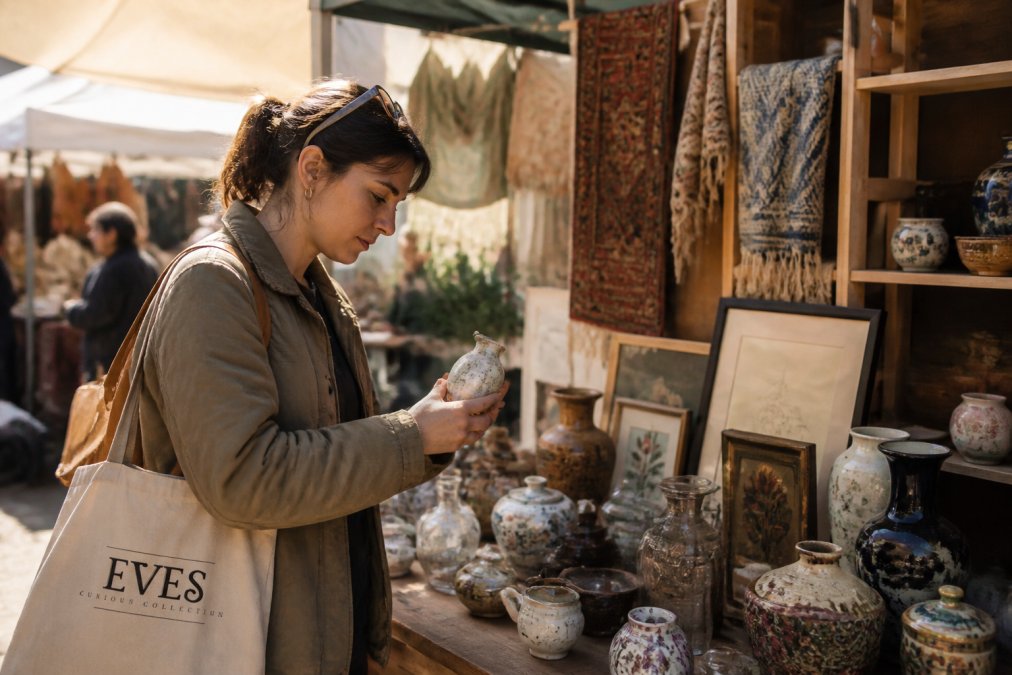
Local sourcing beats online shopping for vintage because you can inspect condition, check for repairs, and negotiate. Estate sales, flea markets, thrift stores, and auction houses operate on different rhythms, and knowing which to visit when saves hours. It is also the channel most online guides skip, which is why the best pieces tend to come from it.
How the Main Local Channels Compare
- Estate sales: best for complete collections and higher-quality furniture. Sales typically run two to three days, with prices often reduced on the final day. Arrive early on day one for first pick, or late on the last day for the deepest discounts.
- Flea markets: best for small decorative objects and textiles. Dealers restock overnight, so arrive at opening. Cash moves faster than card, and bundling three or four items usually earns a better price than buying one.
- Thrift stores: unpredictable but cheap. Donation volume peaks on weekends, so shelves are fullest Monday and Tuesday. Visit mid-week for the best selection before resellers clear the aisles.
- Auctions: best for specific pieces and full sets. Preview day is where you inspect condition; the auction itself is where you set a hard maximum before you bid and never exceed it.
- Estate sale listing sites and local classifieds: the fastest way to plan a route. Most sales post photos 24 to 48 hours in advance, so you can decide which to visit first.
How to Date and Inspect a Piece Before You Buy
Three things to check before buying vintage: look underneath and behind, where repairs and water damage hide; test anything mechanical; and ask whether the price is firm, then be ready to walk away.
A few dating signals that experienced buyers use:
- Construction: dovetail joints, hand-cut screws, and solid wood backs suggest older production. Staples, particle board, and Phillips-head screws point to later manufacturing.
- Marks: a maker's stamp, impressed signature, or paper label on the underside is the single most reliable clue. Photograph it and search the mark before you commit.
- Wear patterns: genuine age shows uneven wear on edges and handles. Uniform distressing is usually a modern reproduction.
- Smell: musty odors often mean long-term moisture exposure, which is difficult and sometimes impossible to reverse.
Pricing, Negotiation, and What to Walk Away From
Vintage pricing is not fixed like retail. A few rules:
- Estate sale prices are usually firm on day one and negotiable on the final day.
- Flea market prices are almost always negotiable, especially for cash and multiple items.
- Auction prices are set by the room, not the seller, so a hard maximum is the only protection.
- Thrift store prices are fixed, but restocking schedules and clearance tags create predictable discounts.
Walk away from structural damage that affects function: cracked frames, water-swollen wood, rewired lamps with exposed connections, and upholstery with pet or smoke odor. Cosmetic wear, a loose joint, or a missing knob is usually repairable and often negotiable.
For guidance on what "vintage" versus "antique" actually means in the resale trade, the U.S. Federal Trade Commission guidance on advertising and labeling claims is a useful reference point for how sellers should describe goods honestly.
The Local Sourcing Advantage
Buying locally is also one of the most effective sustainability moves in decor. A piece that already exists does not require new raw materials, new manufacturing, or new shipping. The U.S. Environmental Protection Agency's guidance on reducing waste through reuse outlines why reuse and repair sit above recycling in the waste hierarchy. Local sourcing puts that principle into practice, one estate sale at a time.
How to Style Eclectic Home Decor Without the Clutter
Eclectic styling works when it follows a rule, not every impulse. The most reliable is the 70/20/10 split: roughly 70 percent of a room in a consistent base (neutral walls, one dominant material), 20 percent in a secondary tone or era, and 10 percent in genuine wildcards.
That last 10 percent is where your funky, handcrafted, one-of-a-kind pieces live. Containing them is what keeps a room feeling curated instead of chaotic.
A few habits that make the difference:
- Repeat one element across the room, such as brass or a single accent color, to tie unrelated objects together
- Group small decorative objects in odd numbers on a tray or shelf
- Leave visible empty space; clutter reads as unfinished, not as collected
- Keep sightlines clear at eye level so statement pieces can breathe
How to Mix Modern and Vintage Decor in One Room
Mixing modern and vintage decor works best when you balance weight, not eras. A heavy antique armoire needs light modern pieces around it; a clean-lined modern sofa benefits from one textured vintage textile or lamp.
Start with the largest piece in the room and decide whether it is the anchor or the accent. If the anchor is vintage, keep the rest restrained. If the anchor is modern, you have more freedom to layer in older objects.
Practical pairings that hold up:
- Mid-century wood furniture with contemporary matte ceramics
- A traditional rug under a modern sectional
- Vintage framed art on a plain painted wall
- Antique brass lighting against neutral rustic surfaces
Interior styling at this level is less about matching and more about contrast with intent. The goal is a room where each piece looks like it was chosen, not inherited by accident.
Sustainable and Ethical Sourcing: How to Verify What You Buy
Verifying sustainable and ethical sourcing comes down to three questions: who made it, what it is made from, and what happens at the end of its life. If a seller cannot answer the first two, treat the sustainability claim as marketing.
Here is a simple verification checklist you can run before any purchase:
- Does the listing name the maker or workshop?
- Are materials listed specifically, not as "mixed" or "premium"?
- Is there a repair or replacement policy?
- Does the seller describe how the item is packaged and shipped?
- For vintage, is the item genuinely secondhand rather than reproduced?
Buying secondhand is one of the most effective sustainability moves available for decor, since it extends the life of an object that already exists. The U.S. Environmental Protection Agency's guidance on reducing waste through reuse outlines why reuse and repair sit above recycling in the waste hierarchy.
Small-batch and handcrafted production also produces less overstock than mass manufacturing, because makers build to demand rather than a warehouse forecast, a structural advantage, not a marketing line.
Budget-Friendly Ways to Get the High-End Look
You can get the high-end look on a modest budget by spending where the eye lingers and saving everywhere else: invest in lighting, hardware, and one large piece; save on rugs, frames, and small decorative objects.
Lookalike strategies that genuinely work:
- Swap builder-grade cabinet knobs for solid brass or matte black hardware
- Replace lampshades before replacing lamps
- Reframe thrifted art in a simple, consistent frame style
- Use one large rug instead of several small ones
- Paint or refinish a secondhand piece rather than buying new
DIY and upcycling deserve more credit than they get. A coat of paint on a dated frame, a recovered cushion, or a repaired ceramic joint can turn a cheap find into something bespoke. The catch is time: if a repair costs more than the object is worth, let it go.
For affordable statement pieces that do not require a project, Eve's Curious Collection stocks rotating finds like the Moving Sand Art Landscape Table Lamp, which delivers a moving, gallery-like display for under thirty dollars, and the Anxiety Bookshelf | Shake Away Your Anxiety, a small desk object that doubles as a conversation starter.


Frequently Asked Questions
What are the best websites for finding unique home decor?
Start with curated marketplaces that vet their sellers, like Eve's Curious Collection, which hand-picks items across electronics, jewelry, and household supplies. For artisan goods, try platforms that specialize in small-batch makers. Estate sale aggregator apps and local thrift store listings also surface one-of-a-kind pieces you won't find on big-box sites. The key is choosing shops where a real person selects the inventory, not an algorithm.
How do I mix modern and vintage decor without it looking messy?
Pick one anchor piece, like a clean-lined modern sofa, then layer in vintage accents such as a handcrafted textile or an antique mirror. Keep a consistent color palette across both eras so the eye has something to follow. Limit vintage items to two or three per room and give each one breathing room. The contrast works when modern pieces provide structure and vintage finds add warmth.
How can I tell if a product is actually handmade or just marketed that way?
Look for specifics: named artisans, small-batch production notes, and photos of the making process. Ask the seller directly about materials and origin, and check whether reviews mention quality inconsistencies, which often signal mass production. Curated shops like Eve's Curious Collection publish product details that help you judge. If a listing uses vague language like 'artisan-inspired' with no maker named, treat it as a red flag.
Is it worth paying more for unique decor instead of buying cheap alternatives?
It depends on the piece. For statement items you'll see daily, like a moving sand art lamp or a levitating ornament, spending a bit more gets you better materials and a design that won't look dated next season. For filler accents, budget options work fine. A good rule: invest in three to five anchor pieces per room and keep the rest affordable. That balance gives you a curated look without overspending.
Decorating around your own taste takes more discipline than decorating around a trend, and that is exactly why the result lasts longer. If the browsing and sourcing part feels like work, Eve's Curious Collection exists to make it easier, with hand-picked products, an inventory that keeps changing, and fast shipping straight to your door. Start with one piece that makes you curious, then build the room around it. Shop Now and see what turns up.


